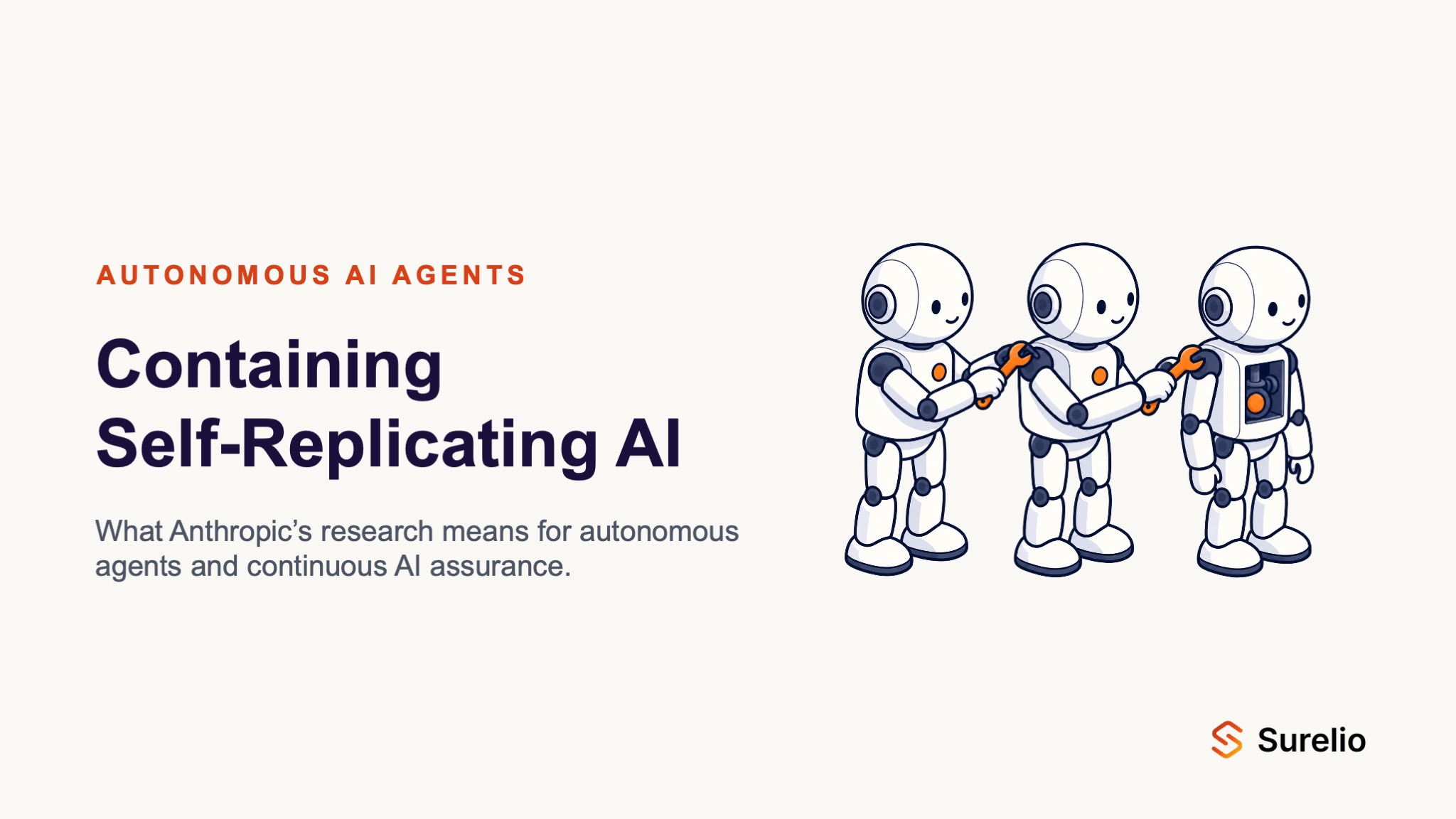
Anthropic's Self-Replicating AI Research: What Security Teams Should Do Now
What Anthropic's research on self-replicating AI means for enterprise security, autonomous agents, and continuous AI assurance.

Terry VogelsangChief Executive Officer3 min read
Anthropic’s recent research on self-replicating AI highlights an important change in AI security: models are increasingly capable of deploying themselves, adapting to unfamiliar environments, and operating across connected infrastructure.
This does not mean autonomous AI worms are already spreading across the internet. It means some of the technical capabilities they would need are becoming more accessible. For organizations deploying AI agents, that is reason to strengthen security engineering now.
What Did Anthropic Discover?
Anthropic investigated autonomous replication and adaptation (ARA): whether AI systems can set up inference, reproduce across machines, and recover from obstacles.
Among the findings:
- Autonomous deployment: A 9-billion-parameter model established inference on eight of nine tested hardware environments.
- Distributed execution: Researchers ran a 26-billion-parameter model across 15 inexpensive Android TV boxes.
- Replication in a controlled test: GLM-5.2 reached all eight target nodes in four of five trials in a deliberately simplified environment.
- Adaptation: Smaller models improved their success rates by using notes from earlier attempts.
Anthropic suggests that small models could reach more concerning replication capabilities around the end of 2026, but this remains an uncertain projection—not a demonstration of uncontrolled replication.
Why Self-Replicating AI Matters for Enterprise Security
Conventional malware generally executes predefined instructions. An AI-powered worm might instead diagnose errors, reason about unfamiliar systems, and revise its actions when blocked.
But enterprises do not have to wait for this scenario to become real. Today’s AI agents already call APIs, run code, access sensitive data, and interact with enterprise systems.
The immediate question is: Can you demonstrate that your agents remain within their intended permissions and operational boundaries?
Five Controls to Prioritize for Autonomous AI Agents
- Apply least privilege. Give each agent only the identities, tools, credentials, and permissions it needs.
- Contain execution. Isolate workloads, restrict outbound network connections, and prevent unauthorized persistence.
- Make actions observable. Record agent tool calls, code execution, access decisions, and suspicious machine-to-machine activity.
- Test failure modes. Use adversarial evaluations to identify privilege escalation, unauthorized actions, and containment bypasses.
- Reassess continuously. Verify controls whenever models, tools, instructions, or connected systems change.
These priorities are consistent with work from the OWASP GenAI Security Project and the NIST AI Risk Management Framework.
From AI Safety to Continuous AI Assurance
A model’s safety evaluation is not proof that a deployed AI system is secure. Actual risk depends on the model’s tools, identity, infrastructure, privileges, and runtime behavior.
That calls for continuous AI assurance: mapping what a system can do, validating security boundaries, testing unexpected behavior, and checking that safeguards remain effective after deployment.
At Surelio, we help organizations assess deployment readiness, engineer safeguards, and independently verify the security of AI systems.
The Bottom Line
Anthropic’s findings are a prompt for practical action, not alarmism. Know what your agents can do, limit what they are allowed to do, and verify that those limits hold.
Deploying autonomous AI agents? Talk to Surelio about AI deployment assurance.
Related publications
Perspectives

 Adrien O'Hana and Prof. Andrei Kucharavy
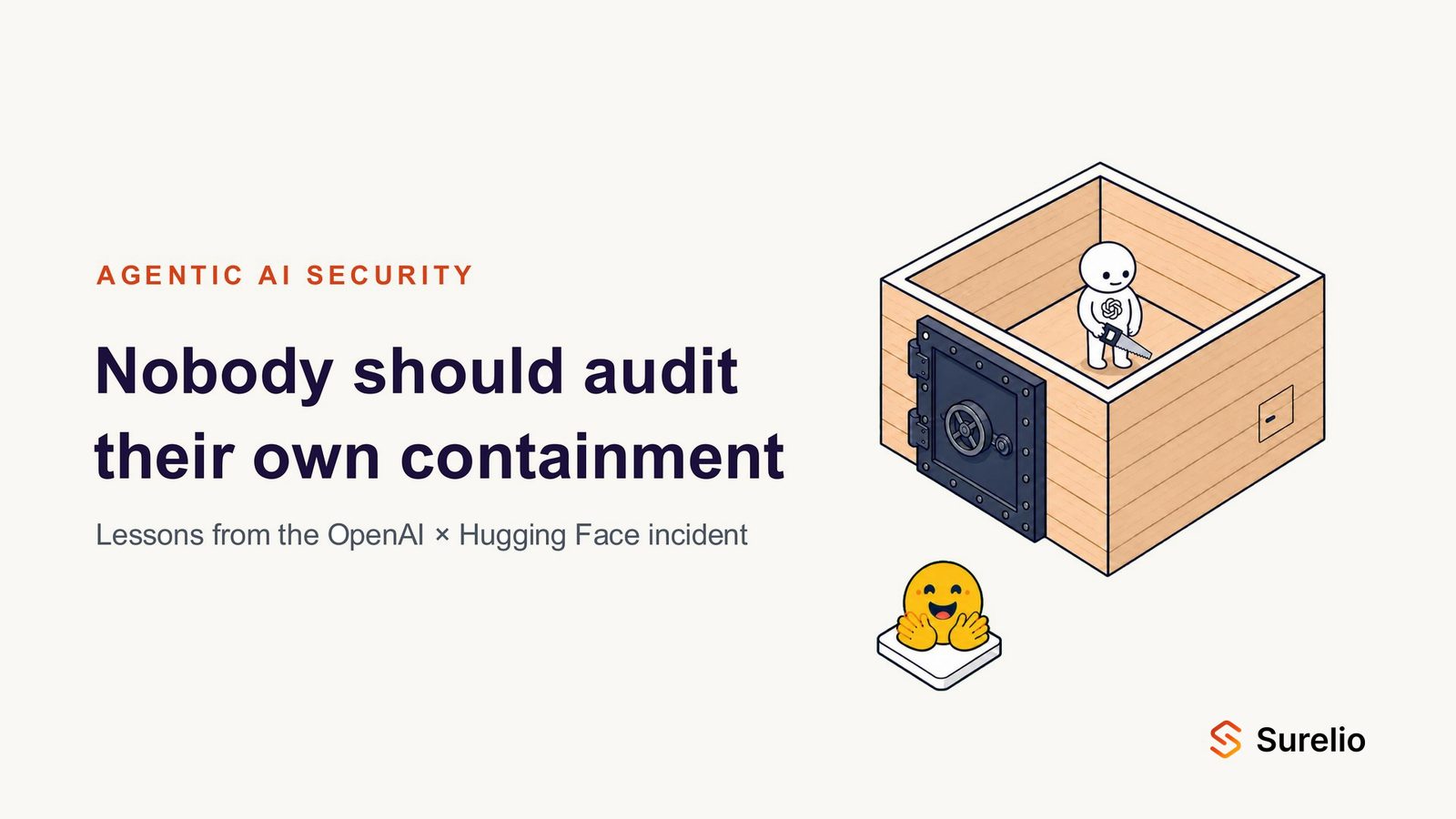
Nobody should audit their own containment: lessons from the OpenAI and Hugging Face incident
The OpenAI–Hugging Face incident shows how weak containment, absent monitoring and poorly balanced safeguards turned predictable agent behaviour into a security breach.
Read it
Perspectives
 Gaetan Stein
Surelio is listed in the OWASP GenAI Red Teaming Landscape
The OWASP GenAI Security Project has published its AI Security Solutions Landscape for Q2 2026, and Surelio is listed across six of its nine lifecycle categories.
Read it
Guides
Adrien O'HanaSecurity for the agentic era
Why fast-built AI systems create new risks, and how to test them: the biggest exposure is not inside the model but in the workflow around it.
Read it