Corporate AI safety
Protecting brand, customers, and trust with large-scale testing: how to turn policy into testable rules and ship only when the evidence holds.

Adrien O'HanaChief Technology Officer

Gaetan SteinChief Operating Officer
5 min read
Introduction
AI systems are now customer-facing: they write emails, answer support tickets, surface recommendations, and draft policies. They are also deployed internally, where they must follow company guidelines and support employees responsibly. That visibility creates reputational risk. Even with safety-aligned models, an agent can still hallucinate, produce off-brand or harmful content, or violate internal guidelines in subtle ways. The real question is whether the system behaves as intended, consistently and at scale.
Safety here means assuring acceptable behavior, aligned with company policy and values, under realistic use. Failure leads to brand damage, regulatory exposure, and lost customer trust. Frameworks such as the NIST AI RMF define this as ongoing risk management12.
Why safety matters
- Reputation moves faster than incident response. Public red-teaming has shown jailbreaks and policy violations still happen in practice, even on frontier systems. At DEF CON’s public exercise, teams repeatedly coerced models into breaking their rules, underscoring why proactive testing is necessary3.
- Regulation is advancing. The EU AI Act brings requirements for risk management, transparency, incident reporting, and for high-impact or general-purpose models with systemic risk, guidance now calls out evaluations, adversarial testing, and serious-incident reporting. Penalties can reach €35M or 7% of global turnover45.
- Standards demand process. The NIST AI RMF and its Generative AI Profile, plus ISO/IEC 42001, all emphasize documented governance, evaluation, monitoring, and continuous improvement1267.
What safety means in practice
Safety is not a single metric, it is a set of behaviors to test, monitor, and enforce:
- Content integrity. No toxicity, harassment, hate; no incitement to violence or self-harm; no sexual content where prohibited. Public datasets such as RealToxicityPrompts help, but testing must reflect brand rules8.
- Factual reliability. Minimize hallucination on high-stakes topics; handle uncertainty; escalate when confidence is low.
- Privacy and data handling. Prevent repetition or leakage of personal data; apply masking and consistent refusal behavior.
- Fairness and non-discrimination. Ensure stable outputs across demographics, regions, and languages.
- Policy and tone adherence. Stay on-brand, add disclaimers where required, and adapt to each channel.
- Correct refusals. Refuse when policy requires, but avoid over-refusal on valid requests.
- Robustness. Preserve expected behavior under paraphrase, long context, tools, or adversarial phrasing.
Why manual review is not enough
- Scale and drift. Models, prompts, data, and tools change quickly. Spot checks cannot cover the scenario space or catch regressions after updates.
- Coverage and comparability. Reliable safety requires metrics and trends, not anecdotes. Observability platforms such as LangSmith and Langfuse provide structured tracing, scoring, and experiment tracking across thousands of prompts. Runtime safety layers and trust-and-safety services such as ActiveFence can flag and block harmful content in real time. Together these make large-scale evaluation and monitoring practical.
- Evidence for compliance. Regulators and auditors expect test plans, pass-fail criteria, and logs. Informal reviews do not suffice. NIST, its GenAI Profile, and ISO/IEC 42001 all stress documented processes and ongoing monitoring1267.
How to operationalize safety testing
1) Translate policies into testable rules. Convert conduct codes and product guidelines into machine-checkable specifications. Examples: “Never generate identity-based insults,” “Do not fabricate legal advice,” “Always include a disclaimer in medical contexts,” “Never output unmasked personal data.”
2) Build a test suite reflecting real use. Combine:
- Public benchmarks such as HELM, HELM Lite, and RealToxicityPrompts to catch known issues9108.
- Domain-specific scenarios from your markets, languages, and channels.
- Adversarial probes generated automatically to expose edge cases (see HarmBench and recent automated red-teaming work)111213.
3) Automate at scale. Run thousands of tests per release. Add automated red teaming and set release gates in CI/CD to block deploys when safety metrics regress141112.
4) Use multiple evaluation methods. Blend rule-based checks, classifier models for toxicity or PII, and human audits for ambiguous cases. Observability platforms can unify these signals into dashboards that track regressions over time.
5) Monitor in production. Enable reporting, route risky topics for human review, sample conversations for audits, and use runtime safety layers to detect and block harmful or policy-violating outputs before users see them.
What to measure
- Unsafe response rate by category and channel.
- Refusal accuracy for required-refusal versus allowed prompts.
- Hallucination rate on curated fact sets.
- Personal data exposure rate and time-to-remediation.
- Disparity gaps across demographics and languages.
- Regression rate per release and time-to-fix.
Key takeaways
- Safety is behavioral assurance. It ensures agents represent organizational values and policies.
- Manual review is insufficient. Reliable safety requires large-scale, automated, repeatable testing.
- Observability and runtime safety make it feasible. Platforms for tracing, evaluation, and moderation enable measurement, monitoring, and protection at scale.
- Standards and regulation demand evidence. NIST, ISO, and the EU AI Act require documented risk management and evaluation.
- Make safety a release requirement. Define specifications, test at scale, and block deployment when failures exceed tolerance.
Conclusion
Safety protects brand, customers, and trust. Organizations that succeed will turn policy into testable rules, use observability to evaluate at scale, and ship only when evidence shows agents behave as intended. Safety is continuous, keeping pace with evolving models, tools, and regulations.
Quick safety checklist
- Define safety specifications from policy (toxicity, PII, fairness, tone, refusal, robustness).
- Build a mixed test suite with public benchmarks, domain scenarios, and adversarial probes98111213.
- Automate in CI/CD with release gates and trending dashboards141112.
- Blend evaluators using rules, classifiers, LLM-as-judge, and targeted human review.
- Monitor in production with runtime safety, sampling, and incident playbooks.
Footnotes
-
NIST. Artificial Intelligence Risk Management Framework (AI RMF 1.0). January 2023. ↩ ↩2 ↩3
-
NIST. Artificial Intelligence Risk Management Framework: Generative Artificial Intelligence Profile (NIST AI-600-1). July 2024. ↩ ↩2 ↩3
-
Axios. Hackers force AI chatbots to break their own rules. April 3, 2024. ↩
-
Simmons & Simmons. EU AI Act compliance: How to prepare? 2024. ↩
-
Reuters. AI models with systemic risks given pointers on how to comply with EU AI rules. July 18, 2025. ↩
-
ISO. ISO/IEC 42001:2023 Artificial Intelligence — Management system (AIMS). 2023. ↩ ↩2
-
NIST. NIST AI RMF Playbook (companion to AI RMF 1.0). 2023–present. ↩ ↩2
-
Gehman, S., Gururangan, S., Sap, M., Choi, Y., & Smith, N. A. RealToxicityPrompts: Evaluating Neural Toxic Degeneration in Language Models. 2020. ↩ ↩2 ↩3
-
Stanford CRFM. HELM: Holistic Evaluation of Language Models. 2022. ↩ ↩2
-
Stanford CRFM. HELM Lite. (2024–2025). ↩
-
Mazeika, M. et al. HarmBench: A Standardized Evaluation Framework for Automated Red Teaming and Robust Refusal. ICML 2024. ↩ ↩2 ↩3 ↩4
-
Lin, L., et al. Against the Achilles’ Heel: A Survey on Red Teaming for Generative Models. 2024. ↩ ↩2 ↩3 ↩4
-
Anthropic (Bai, Y. et al.). Constitutional AI: Harmlessness from AI Feedback. December 2022. ↩ ↩2
-
OpenAI. Advancing red teaming with people and AI. 2024. ↩ ↩2
Related publications
Guides
Adrien O'HanaSecurity for the agentic era
Why fast-built AI systems create new risks, and how to test them: the biggest exposure is not inside the model but in the workflow around it.
Read it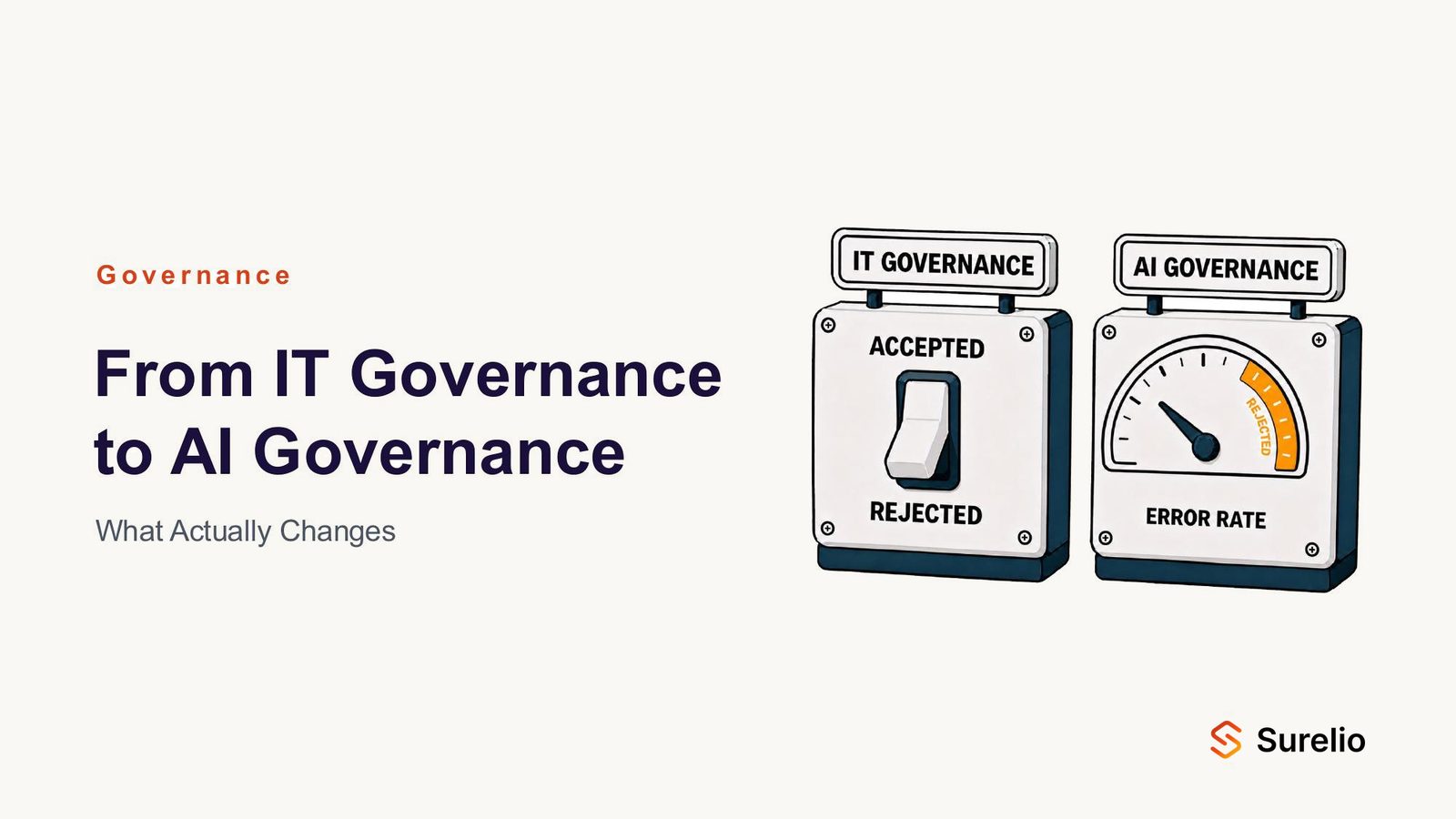
Guides
 Hugo Medori
From IT governance to AI governance: what actually changes
IT governance took twenty years to mature. AI systems challenge several of its core assumptions: every governance requirement must now become measurable and testable.
Read it
Perspectives
 Terry Vogelsang
Anthropic's Self-Replicating AI Research: What Security Teams Should Do Now
What Anthropic's research on self-replicating AI means for enterprise security, autonomous agents, and continuous AI assurance.
Read it