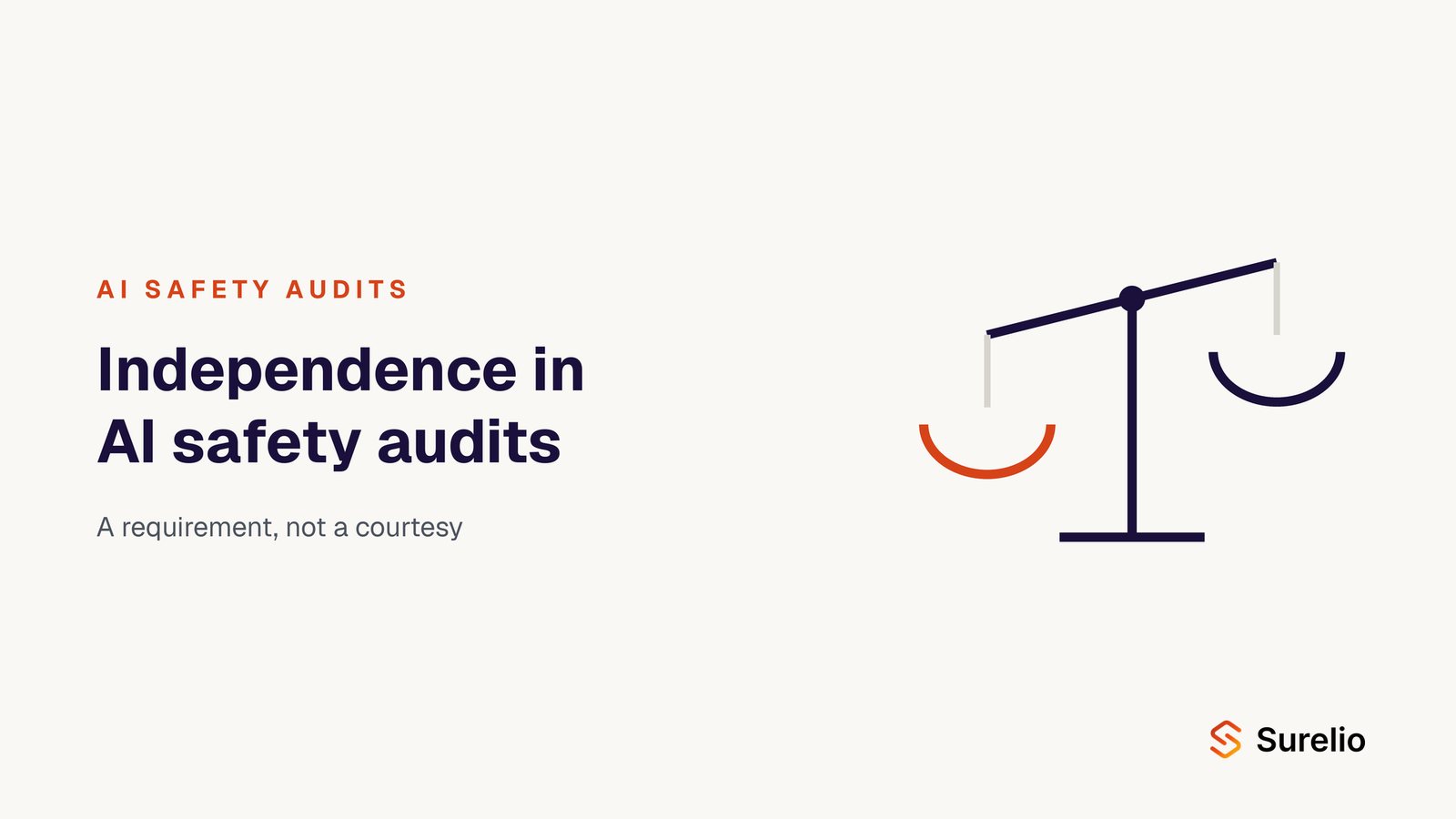
Independence in AI safety audits: a requirement, not a courtesy
AI safety audits require the same independence as financial audits — a consulting firm cannot be both judge and jury on a system it helped build.

Gaetan SteinChief Operating Officer4 min read
As artificial intelligence systems increasingly influence decisions in healthcare, finance, hiring, and critical infrastructure, the safety of these systems is not a theoretical concern—it is a real-world responsibility. Independent audits are one of the most important safeguards we have. But just as in financial auditing, independence is not an optional virtue. It is the foundation of credibility.
When it comes to AI Safety, the stakes are higher than technical performance. We are talking about bias, fairness, unintended harms, systemic vulnerabilities, and potential cascading risks. To address these, an AI Safety audit must be free from conflicts of interest.
Why consulting firms are a risky bet to audit AI solutions
- Safety is about calling out risks. If the same firm that helped design or tune a system is responsible for identifying its risks, it may struggle—consciously or unconsciously—to highlight safety flaws that point back to its own earlier work.
- Incentives can blur judgment. AI consultants often rely on long-term relationships. Raising red flags in an audit might jeopardize a client contract, even if it’s the right call for safety.
- Blind spots run deep. A team that built part of a system may not be well-positioned to challenge its own design assumptions—precisely where safety vulnerabilities often hide.
In short: a firm cannot be both judge and jury. The same organization that helps develop a system cannot credibly be the one to declare it safe.
Lessons from accounting: why separation is non-negotiable
This principle is well established elsewhere. In accounting, auditors cannot also act as consultants for the same company because the conflict of interest undermines trust. An accountant who designed a company’s books cannot be the one to certify their accuracy.
The same logic applies to AI Safety: you cannot be both the architect and the auditor, the advisor and the arbiter. The roles must be distinct. Otherwise, the very idea of an “audit” collapses into a self-assessment.
The added dimension of AI safety
Unlike general system audits, AI Safety audits deal with harms that may be subtle, emergent, and long-term. A biased credit model may affect millions over time. A misaligned medical diagnostic tool may amplify risks in ways no one predicted.
Independence ensures:
- Rigor in surfacing hidden risks, even those inconvenient to acknowledge.
- Trustworthiness in public communication, especially as regulators demand transparency.
- Accountability at the societal level, since AI Safety failures rarely harm just one organization—they spill over into communities and markets.
A constructive path forward
This doesn’t mean consultancies have no role in AI Safety. On the contrary, they play a vital part in:
- Building safer systems from the start,
- Implementing best practices for transparency and governance,
- Supporting remediation once risks are identified.
But the audit itself must be the responsibility of an independent party. Consulting firms can collaborate by providing documentation, data access, and context—but they cannot credibly “mark their own homework.”
For organizations seeking safety audits
If you’re evaluating an AI Safety audit partner, key questions include:
- Has this firm been involved in designing or implementing the system under review?
- If yes, how do they guarantee separation between build and audit functions?
- What external checks or peer reviews validate their audit methodology?
- Do they disclose conflicts of interest clearly?
By prioritizing independence, companies not only meet regulatory expectations but also demonstrate to users, investors, and society that they take AI Safety seriously.
Key takeaways
- AI Safety audits must maintain the same independence standards as financial auditing.
- Consulting firms cannot credibly audit systems they helped build or design.
- Independence ensures rigor, trustworthiness, and societal accountability.
- Consultancies can support AI Safety without conducting the audit itself.
- Organizations should prioritize independent auditors to demonstrate genuine commitment to safety.
Closing thought
AI Safety is too important to compromise. Just as no firm can both prepare and audit financial statements, no consultancy should both build and certify the safety of the same AI system. An auditor cannot be judge and jury. Independence is not an inconvenience; it is the bedrock of trustworthy AI governance.
Related publications
Perspectives
 Terry Vogelsang
Anthropic's Self-Replicating AI Research: What Security Teams Should Do Now
What Anthropic's research on self-replicating AI means for enterprise security, autonomous agents, and continuous AI assurance.
Read it
Perspectives
 Adrien O'Hana and Prof. Andrei Kucharavy
Nobody should audit their own containment: lessons from the OpenAI and Hugging Face incident
The OpenAI–Hugging Face incident shows how weak containment, absent monitoring and poorly balanced safeguards turned predictable agent behaviour into a security breach.
Read it
Perspectives
Adrien O'HanaMythos, nine weeks on
Mythos is not much better at offensive cyber than the models beside it. What changed is the entry price — and the answer is ordinary defensive discipline, run at the speed the threat now moves.
Read it