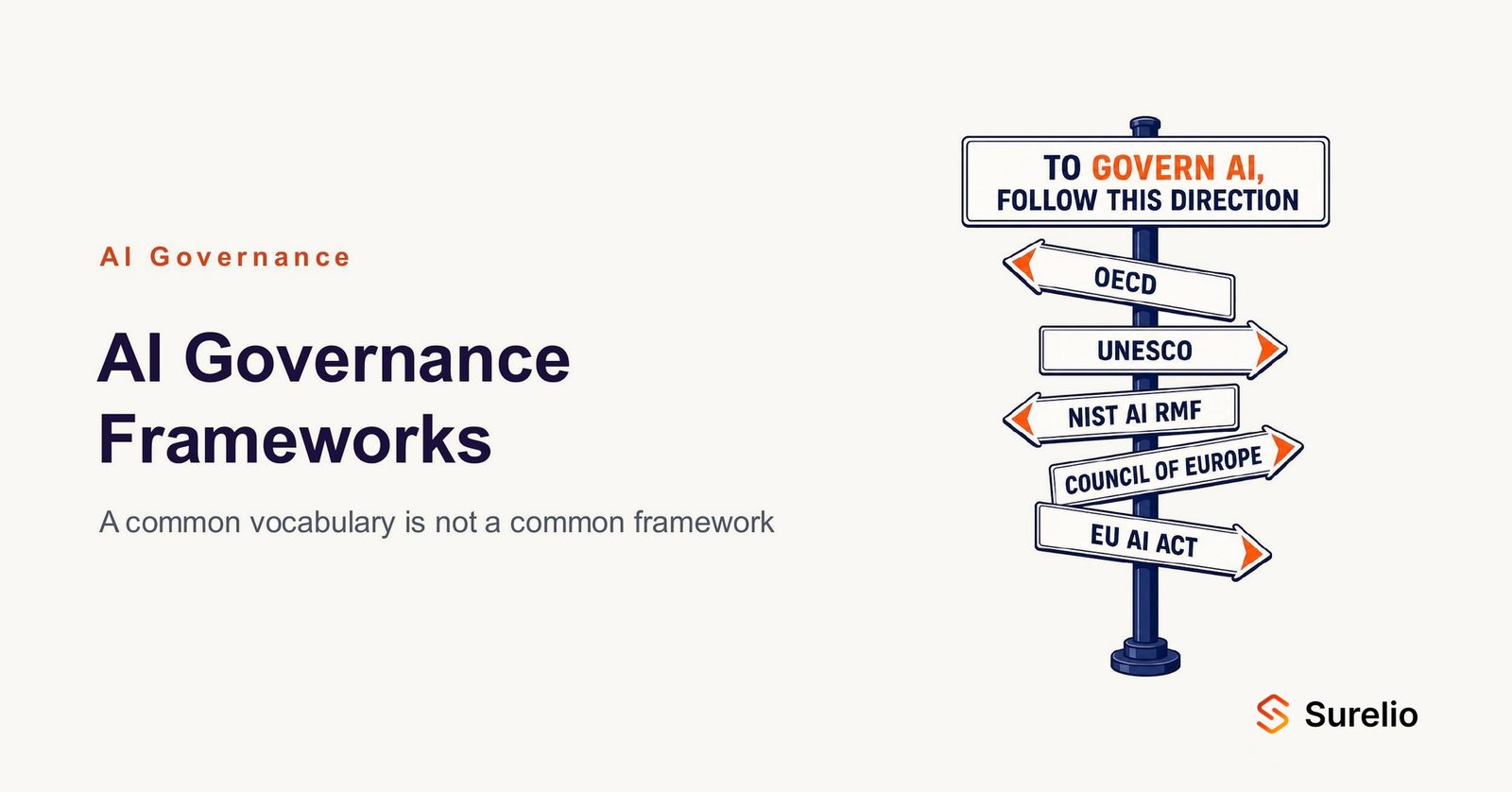
AI governance: a common lexicon does not make a common framework
Transparency, robustness, fairness, accountability: the same principles appear in every AI framework. Convergence is real as to their names; it is absent as to what counts as a breach.

Hugo MedoriAI Researcher16 min read
Introduction: principles in circulation
Over the past decade or so, texts purporting to define acceptable AI have proliferated. A survey published in 2019 had already identified eighty-four sets of ethical guidelines, most of them non-binding documents produced by companies, professional associations and international organisations1. Since then, that output has changed less in volume than in kind: it has shifted from statements of principle towards binding rules, and that shift is the subject of this article. Anyone who reads in succession the OECD Recommendation on Artificial Intelligence (2019, revised in 2024), the guidelines of the Commission’s high-level expert group (2019), the UNESCO Recommendation (2021), the NIST risk management framework (2023), the Council of Europe Framework Convention (2024) and the European regulation2 (known as the EU AI Act) comes away with an impression of unanimity: transparency, robustness, fairness, accountability, human oversight. An international consensus would appear to be taking shape, with nothing left to do but implement it. These six texts form the corpus of this article. ISO/IEC 42001, often cited alongside them, is not part of the corpus: it does not state principles; it organises a management system.
There is genuine convergence in the names of the principles, but not in what counts as a breach from one text to another. There are two reasons for this. First, the resemblance is not the result of spontaneous convergence but of a clear lineage: recital 27 of the European regulation expressly cites the seven requirements formulated in 2019 by the Commission’s high-level expert group3, which in turn drew on the principles that the OECD had just adopted and the G20 had endorsed that same year. This is not a case of fifty institutions independently reaching agreement; it is a case of principles circulating between them. Second, this common lineage ends where governance begins: when one must determine how compliance with a principle is to be demonstrated, to whom, and what consequences follow if it cannot be demonstrated.
How soft law and hard law shape each other
Classifying all these texts as either soft law or binding law is not particularly instructive. What matters is how they shape one another.
The first movement is upward and concerns content. The OECD Recommendation of May 2019 has no legally binding force, and neither does UNESCO’s, adopted in November 2021 by its 193 member states. The European guidelines, moreover, presented themselves as non-binding. Yet they provided the substance of the 2024 European regulation: here, soft law served as the drafting laboratory for hard law. The Council of Europe Framework Convention, opened for signature in September 20244, occupies an intermediate position, that of a treaty binding on its parties but framed as obligations of conduct: to document, to allow challenges, to provide a remedy. For example, the principle of “awareness and literacy”5 stated by UNESCO in 2021 has its binding equivalent in Article 4 of the regulation, on AI literacy, and in Article 20 of the Council of Europe Convention.
The second movement is downward and concerns operationalisation. Here, soft law serves to translate genuinely binding obligations into concrete terms, directly or indirectly. For example, Article 40 of the EU AI Act6 provides that systems complying with harmonised standards benefit from a presumption of conformity with the legal requirements. The Commission therefore asks the European standardisation organisations (for AI, the CEN-CENELEC JTC 21 committee) to develop the technical expression of those requirements: a voluntary standard, drawn up by a private body recognised as a standardisation organisation by the European Union, becomes the practical reference point for a legal obligation. ISO/IEC 42001 and the NIST AI RMF occupy a different position (the former being certifiable by an accredited third party, unlike the latter), but neither directly establishes conformity with the regulation. They are nonetheless useful guides, since the requirements they set are to a large extent comparable.
This mechanism presupposes, however, that harmonised standards exist. To date, no JTC 21 standard has been cited in the Official Journal of the European Union: no standard currently gives rise to the presumption of conformity. The first step has been taken with EN 18286, devoted to the quality management system required by Article 17: CEN and CENELEC approved it on 12 July 2026 and published it at the end of the same month. But until its reference is published in the Official Journal, it produces no legal effect. The standards on risk management (Article 9), cybersecurity (Article 15) and bias (Article 10) are still at the public-enquiry or drafting stage, despite the measures that CEN and CENELEC themselves describe as exceptional, adopted in October 2025.7
This delay has produced the most revealing development of the period: the technical standard did not catch up with the law; the law waited for the standard. Regulation (EU) 2026/1744, known as the Digital Omnibus, in force since 27 July 2026, defers the application of the obligations relating to the high-risk systems listed in Annex III until 2 December 2027, and those of Annex I until 2 August 2028, explicitly because the harmonised standards and the conformity assessment infrastructure were not ready.8 Article 41 nonetheless allowed the Commission to adopt common specifications in the absence of harmonised standards: it had a public regulatory alternative available, but chose instead to postpone the deadline. Soft law therefore does not merely accompany hard law; it conditions its operation.
It is therefore important to clarify what an ISO/IEC 42001 certification demonstrates, and what it does not. The standard sets out the requirements for an AI management system. It is certifiable by an accredited third party, and it requires an organisation to document decision-making responsibilities. It sets no threshold, however, and above all it confers no presumption of conformity, which Article 40 reserves for harmonised standards. It demonstrates that an organisation has an AI management system; it does not demonstrate that a given AI system satisfies the requirements of Chapter III.
The next question is what these texts genuinely share once mere vocabulary has been set aside.
The same word, a different breach
The most obvious point must be made at the outset: a core of common principles does indeed exist. Six requirements are found in all six texts of the corpus, in much the same terms9, under only slightly different headings: what the European expert group calls “human agency and oversight” becomes “human oversight and determination” for UNESCO and “human dignity and individual autonomy” in Article 7 of the Council of Europe Convention; what NIST calls “fair with harmful bias managed” is stated elsewhere as “fairness and non-discrimination”. Moreover, the concept of “trustworthy AI” (digne de confiance) is not one principle among others: it is the label applied to the list as a whole. The OECD, the expert group, NIST and recital 27 all place their requirements under that heading. The list shrinks as the texts under consideration become more binding10.
| Principle | Soft law (OECD, AI HLEG, UNESCO) | NIST 2023 (voluntary characteristics) | Council of Europe 2024 (obligations of conduct) | Regulation (EU) 2024/1689 (from recital 27 to an ascertainable breach) |
|---|---|---|---|---|
| Human primacy and human oversight | Recommendation | Addressed under the Govern and Map functions | Art. 7 | Enforceable requirement, Art. 14 |
| Robustness, accuracy, security | Recommendation | Characteristic | Art. 12 | Enforceable requirement, Art. 15 |
| Privacy and data governance | Recommendation | Characteristic | Art. 11 | Data requirement, Art. 10 |
| Transparency and explainability | Recommendation | Characteristic | Art. 8 | Requirements, Art. 13 and 50 |
| Fairness and non-discrimination | Recommendation | Characteristic | Art. 10 | Bias assessment and mitigation, Art. 10(2) |
| Accountability | Recommendation | Characteristic | Art. 9 | Requirements, Art. 16, 17 and 26 |
| Societal and environmental well-being | Recommendation | Absent | Absent | Voluntary code of conduct, Art. 95 |
| “Trustworthy” | Heading for the list | Heading for the list | Principle distinct from reliability, Art. 12 | Subject matter of the regulation, Art. 1; never a requirement |
The status of each principle and what may constitute a breach
How to read the table: none of the first three columns imposes obligations on an operator; the fourth does, but those obligations fall on the States parties. Only the right-hand column identifies conduct that constitutes a breach. It does not reproduce any principle as such: the regulation converts them into precise requirements, and it is those requirements, not the principles from which they derive, that bind the provider.
There is therefore genuine convergence in the names of the principles. That is not enough to constitute a common framework. A simple test, applicable to any pair of texts, shows why: do they really share a principle, or only its name? They share it only if the same conduct constitutes a breach under both. The Council of Europe Convention and the regulation both protect non-discrimination; but a disparity in rates between two populations engages the State under the former, whereas under the latter it engages the provider only if the provider has failed to examine the bias. The underlying fact is the same; the legal breach is not. This test has a direct consequence: where two equally applicable principles conflict, there must be a rule stating which one yields; otherwise, the breach once again becomes impossible to determine. A list without an explicit conflict rule is not a genuine framework but merely a common vocabulary. The foundational document of the EU framework had acknowledged as much, calling for the continuous identification, evaluation, documentation and communication of “fundamental tensions between different principles”11. Moreover, the term heading the list fares worst under this test. “Trustworthy” does not denote a property of the system but a relation to whoever observes it: trust is granted, it is not measured, and nothing can therefore count as a breach of it. NIST says so plainly: trustworthiness is “a social concept that ranges across a spectrum” and a system is only as trustworthy as its weakest characteristic12. The regulation reflects this in its structure: the expression appears fourteen times, twelve of them in the recitals, once in Article 1, which states the subject matter of the regulation, and once in Article 95, where it merely refers to the title of the 2019 guidelines. This reference appears in a provision devoted to voluntary codes of conduct, not in a requirement enforceable against a provider. Providers are not required to be “trustworthy”; they are required to comply with specific requirements.
Two examples of how conflicts between principles are resolved are worth considering:
- First example: a balancing option made available, but not imposed. Non-discrimination versus data minimisation. Detecting bias requires access to sensitive attributes whose processing is generally prohibited under data-protection law. The legislator has removed the obstacle: Article 10(5) authorises, “exceptionally”13, the processing of special categories of data for the sole purposes of bias detection and correction, subject to cumulative conditions, including that no other means are available, that the data not be transmitted, and that they be deleted as soon as the bias has been corrected. The Digital Omnibus has extended this legal basis beyond providers of high-risk systems, subject to a strict necessity test and to mandatory safeguards. The resulting trade-off is not, however, what it first appears: the legislator has made bias testing legally possible, but has not required anyone to carry it out. The organisation still decides whether to test, which populations to examine, which metric to use, and what disparity constitutes bias. The legal obstacle has been removed, but the substantive decision remains with the organisation.
- Second example: the reverse situation, in which the trade-off is displaced. Human oversight versus the usefulness of automation. Article 14 requires “effective” oversight by natural persons, and at the same time requires that those persons be able to “remain aware of the possible tendency of automatically relying or over-relying on the output” of the system14. The regulation prescribes the remedy and names its own failure mode in the same sentence. The tension is shifted to the deployer, whose task is to ensure that oversight is effective, even though its effectiveness cannot be established from documentation alone. Together, these examples define the problem: in the first, the law removes an obstacle without imposing an obligation; in the second, it lays down an obligation while explicitly acknowledging its own weak point. In both cases, the person making the decision is not the person writing the rule.
Under this test, convergence does not disappear, but what converges changes. What these frameworks genuinely have in common is a method (a risk-based approach, a life-cycle perspective, a duty to document). For the rest, the convergence is real as to the names of the principles; it is absent as to what counts, from one text to the next, as a breach. These texts resolve only a handful of explicitly identified conflicts: the prohibited practices of Article 5, the classification in Annex III, Article 10(5), and the two prohibitions added by the Digital Omnibus. All other conflicts are left to the deployer. Soft law acknowledges this explicitly. NIST writes that trade-offs are usually involved and that human judgment must be used15 in setting the metrics and the threshold values; UNESCO accepts that transparency and explainability may need to be balanced against other principles, such as privacy, safety and security16. The regulation takes the same approach: for the stand-alone systems listed in points 2 to 8 of Annex III, the provider weighs the competing considerations alone before declaring conformity through the internal-control procedure in Annex VI, a regime that the Digital Omnibus has deferred until 2 December 2027. The deferral changes the date, not the structure.
Conclusion: what remains to be decided
Adopting a policy is not the same as applying a control, and applying a control is not yet proof that it works. We can now see why AI governance frameworks almost all stop at the first of these three levels: compliance with a list that has no hierarchy cannot be demonstrated. The common lexicon is therefore real, but it is no more than a lexicon. It was born of the circulation of a small number of founding texts, and it survives because none of them established a hierarchy, or any rule for resolving conflicts between competing principles. As soon as the three questions at the heart of governance are asked (what has to be demonstrated, to whom, and what happens if compliance cannot be demonstrated), the texts stop answering in the same way. The convergence is real as to the names of the principles; it is absent as to what counts as a breach.
The practical consequence is clear for an organisation subject to one of these frameworks: aligning its internal policies with a list of principles achieves little, because the same list appears everywhere. What varies, and what creates binding obligations, is how conflicts between principles are resolved; no one will make those balancing decisions on behalf of the deploying organisation.
The remaining question is what an enforceable balancing rule looks like. Four elements are enough to distinguish it from an intention: a threshold, a defined population, a measurement protocol, an escalation trigger. Consider a mutual health insurer whose model reads supporting documents and independently decides whether to reimburse claims below a certain amount. The balancing rule should not say “we take care to ensure the fairness of our models”. It should instead state: the gap in automatic rejection rates between two comparable populations of members must not exceed a specified number of percentage points; it is measured each quarter among claims processed without human intervention; beyond the threshold, automatic delegation is suspended, cases are returned for manual assessment, and the matter is escalated to a specified committee, which records its decision. A regulator can test and challenge a rule of that kind; that is what distinguishes it from a principle.
Footnotes
-
A. Jobin, M. Ienca and E. Vayena, “The global landscape of AI ethics guidelines”, Nature Machine Intelligence, 2019; the study identified eighty-four non-binding sets of ethical guidelines worldwide. ↩
-
In order of citation: OECD, Recommendation of the Council on Artificial Intelligence, OECD/LEGAL/0449, adopted on 22 May 2019, revised on 3 May 2024; AI HLEG, Ethics Guidelines for Trustworthy AI, April 2019; UNESCO, Recommendation on the Ethics of Artificial Intelligence, adopted on 23 November 2021; NIST, Artificial Intelligence Risk Management Framework (AI RMF 1.0), NIST AI 100-1, January 2023; Council of Europe Framework Convention on Artificial Intelligence and Human Rights, Democracy and the Rule of Law, CETS No. 225, opened for signature on 5 September 2024; Regulation (EU) 2024/1689 of the European Parliament and of the Council of 13 June 2024 laying down harmonised rules on artificial intelligence, OJ L, 12 July 2024 (hereinafter “the regulation”). ↩
-
Regulation, recital 27, referring to the Ethics Guidelines for Trustworthy AI drawn up in 2019 by the High-Level Expert Group on Artificial Intelligence (AI HLEG). The OECD principles were endorsed by the G20 in its Ministerial Statement on Trade and Digital Economy of 8 and 9 June 2019. ↩
-
Council of Europe Framework Convention on Artificial Intelligence and Human Rights, Democracy and the Rule of Law, CETS No. 225, opened for signature in Vilnius on 5 September 2024. The substantive principles are set out in Articles 7 to 13, and the procedural safeguards (documentation, challenge, remedy) in Articles 14 and 15. ↩
-
UNESCO, Recommendation on the Ethics of Artificial Intelligence, 2021, principle of “awareness and literacy”; regulation, Article 4 (AI literacy), applicable since 2 February 2025. ↩
-
Regulation, Articles 40 (harmonised standards and presumption of conformity) and 41 (common specifications). The standardisation request addressed to CEN and CENELEC was formalised by Commission Implementing Decision C(2023) 3215 of 22 May 2023; the work falls to the joint technical committee CEN-CENELEC JTC 21. ↩
-
EN 18286:2026, Artificial intelligence - Quality management system for EU AI Act regulatory purposes, approved by CEN and CENELEC on 12 July 2026 and published at the end of the same month; its reference had not been cited in the Official Journal of the European Union at the time of writing, so no standard yet gives rise to the presumption of conformity under Article 40. Other CEN-CENELEC JTC 21 work items: prEN 18228 (risk management, Art. 9), prEN 18282 (cybersecurity, Art. 15) and prEN 18229-1 at the public enquiry stage; prEN 18283 (bias management, Art. 10) at the drafting stage. Exceptional measures adopted by the technical boards of CEN and CENELEC in October 2025; the target is availability in the fourth quarter of 2026. ↩
-
Regulation (EU) 2026/1744 of 8 July 2026, known as the “Digital Omnibus” on artificial intelligence, published in the Official Journal of the European Union on 24 July 2026 and entered into force on 27 July 2026, following approval by the European Parliament on 16 June 2026 and adoption by the Council on 29 June 2026. New deadlines: 2 December 2027 for the stand-alone high-risk systems of Annex III, 2 August 2028 for those of Annex I. ↩
-
Correspondences: AI HLEG, Ethics Guidelines for Trustworthy AI, April 2019, Chapter II (seven requirements); OECD, Recommendation cited above, principles 1.1 to 1.5; UNESCO, Recommendation cited above, section III.2; Framework Convention CETS No. 225, Articles 7 to 13, with human primacy addressed in Article 7; NIST, AI RMF 1.0, § 3. ↩
-
Regulation: the expression “trustworthy” appears fourteen times, twelve of them in the recitals (notably 1, 8 and 27), once in Article 1(1) (subject matter), and once in Article 95(2)(a), where it designates the title of the 2019 guidelines, in a provision relating to voluntary codes of conduct. It appears in no requirement of Chapter III. On societal and environmental well-being: recital 27 and Article 95(2) (voluntary codes of conduct, in particular as regards environmental sustainability). ↩
-
AI HLEG, Ethics Guidelines for Trustworthy AI, April 2019, executive summary, guidance derived from Chapter II. ↩
-
NIST, AI RMF 1.0, § 3: “trustworthiness is a social concept that ranges across a spectrum and is only as strong as its weakest characteristics”. ↩
-
Regulation, Article 10(5), as amended by Regulation (EU) 2026/1744: the legal basis, initially reserved for providers of high-risk systems, is extended to providers and deployers of other AI systems and models, subject to a strict necessity test and to mandatory safeguards (priority recourse to non-sensitive or synthetic data, pseudonymisation, access control, limits on onward sharing, timely deletion). The amendment creates no obligation to detect or correct bias. ↩
-
Regulation, Article 14(1) and (4)(b). ↩
-
NIST, AI RMF 1.0, § 3: “tradeoffs are usually involved […] Human judgment should be employed when deciding on the specific metrics related to AI trustworthiness characteristics and the precise threshold values for those metrics”. ↩
-
UNESCO, Recommendation on the Ethics of Artificial Intelligence, 2021, § 38. ↩
Related publications
Guides
Hugo MedoriFrom IT governance to AI governance: what actually changes
IT governance took twenty years to mature. AI systems challenge several of its core assumptions: every governance requirement must now become measurable and testable.
Read it
Research
 Arthur Wuhrmann
Same model, different behaviour: the hidden cost of OpenRouter's provider lottery
Routing the same open-weight model through four OpenRouter providers changed the refusal rate by 7.6x. Quantization alone doesn't explain it.
Read it
Perspectives
 Terry Vogelsang
Anthropic's Self-Replicating AI Research: What Security Teams Should Do Now
What Anthropic's research on self-replicating AI means for enterprise security, autonomous agents, and continuous AI assurance.
Read it